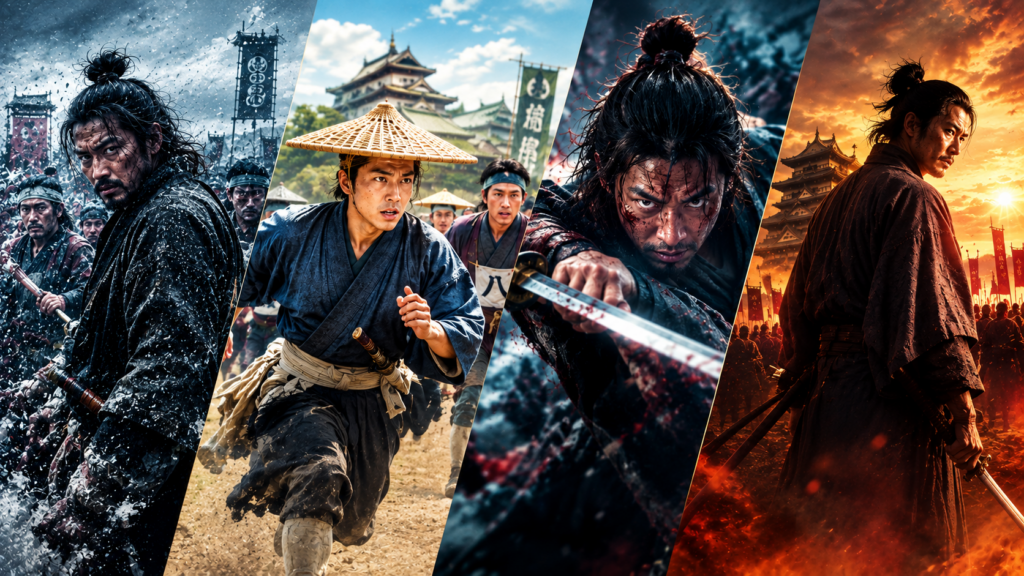
Four Japanese samurai warriors in dramatic battle scenes, representing 11 Rebels, Samurai Marathon, Crazy Samurai: 400 vs. 1, and Samurai Fury

4 Japanese Samurai Movies That Take the Genre in Different Directions

The samurai movie has never been limited to one kind of story.

It can be a brutal war film, a historical adventure, a political rebellion, or even an extended experiment in sword-fighting choreography. The four Japanese films on Amasian TV below show just how different the genre can look depending on what a filmmaker wants to do with it.

From the bloody final days of the shogunate to a 77-minute sword fight, these movies have very different ideas about what a samurai movie should be.

11 Rebels: Samurai Without the Romance

2024 | Directed by Kazuya Shiraishi

11 Rebels takes place during the Boshin War, when Japan was being torn apart following the fall of the Tokugawa shogunate.

The setup is grim. Eleven prisoners are recruited and ordered to defend a fortress against an advancing army. In exchange, they are promised freedom and forgiveness for their crimes. Their chances of surviving are extremely low.

What makes the film interesting is its attitude toward the samurai myth.

Instead of presenting the warrior class as an uncomplicated symbol of honor, 11 Rebels puts criminals and outcasts at the center of the story and surrounds them with political leaders who have their own interests in the conflict. The result is a much rougher version of the period film, with the battle itself becoming the main event.

The movie is particularly interested in what happens when ordinary people are asked to die for causes decided by people far above them.

It’s bloody, bleak, and deliberately uninterested in making war look noble.

Samurai Marathon: When a Race Becomes a Samurai Adventure

2019 | Directed by Bernard Rose

The premise of Samurai Marathon sounds almost like a joke: in 1855, a feudal lord organizes a long-distance race for his samurai.

But there’s a serious reason behind it.

The race is intended to prepare the lord’s warriors for the possibility of an attack, while the political situation surrounding Japan is becoming increasingly tense. One participant is also secretly working as a spy, turning the race into something considerably more complicated than a sporting event.

That unusual premise gives the film a lighter tone than the typical samurai drama.

The runners have to deal with exhaustion, rivalries, mistakes, and the physical demands of the journey, while the larger political story keeps moving around them. The result is part historical adventure, part comedy, and part action film.

It’s a useful reminder that period Japanese cinema doesn’t always have to be solemn. A samurai movie can have room for humor and an unconventional premise without abandoning its historical setting.

Crazy Samurai: 400 vs. 1: One Fight, Taken to the Extreme

2020 | Directed by Yûji Shimomura | Starring Tak Sakaguchi

If the first two films show how much the story of a samurai movie can change, Crazy Samurai: 400 vs. 1 asks a different question:

How long can you sustain a sword fight?

The answer is roughly 77 minutes.

Tak Sakaguchi plays the legendary swordsman Miyamoto Musashi, who arrives at the Yoshioka dojo expecting a duel and instead walks into an ambush involving hundreds of warriors. The majority of the film’s central battle was filmed as a single continuous take.

That filmmaking decision is the movie’s entire identity.

There are obvious tradeoffs. Critics have pointed out that the story and character development are extremely thin, and the repeated combat can become exhausting. But the physical achievement is still unusual. Sakaguchi and the stunt team have to maintain the action, camera movement, positioning, and performance across an extraordinarily long sequence.

It’s less interested in telling you about Musashi than in making you watch what his endurance looks like.

If you want a samurai movie because you want samurai fighting, this is probably the most extreme choice on the list.

Samurai Fury: A Rebellion Against the Shogunate

2025 | Directed by Yû Irie | Starring Yo Oizumi, Kento Nagao, Shin’ichi Tsutsumi

Samurai Fury moves further back in Japanese history, to 15th-century Kyoto, where famine and disease have devastated the population.

Hasuda Hyoe, a wandering warrior who has witnessed the suffering around him, decides that the shogunate’s failure to act has gone too far. He gathers a group of outcasts and begins planning an uprising. His biggest obstacle is Honekawa Doken, a former friend who now stands on the other side of the conflict.

That gives Samurai Fury a different focus from the other films here. The samurai isn’t simply fighting because another warrior challenged him or because a battle has arrived at his doorstep. Hyoe is caught up in a larger political revolt.

The film also has the scale to match that story. With its large cast of rebels, period settings, and battles, it plays more like a historical epic than a contained sword-fighting movie.

And because it was released in 2025, it makes for an interesting pairing with the older samurai traditions represented by the other films on this list.

Four Samurai Movies, Four Different Approaches

Put these four movies next to each other and the differences become pretty clear.

  • 11 Rebels uses samurai warfare to explore sacrifice, class, and the ugliness of war.
  • Samurai Marathon turns the period setting into an unusual historical adventure.
  • Crazy Samurai: 400 vs. 1 strips the story down to an extraordinary endurance test built around one extended fight.
  • Samurai Fury uses the samurai setting for a larger story about rebellion and political corruption.

That’s what makes the genre worth revisiting.

You can come to a samurai movie for sword fights and get a war drama. You can come for history and get a comedy about a race. You can come expecting a traditional adventure and end up watching one of the most unusual long-take action experiments in recent Japanese cinema.

Watch Japanese Samurai Movies on Amasian TV

Whether you’re looking for bloody battlefield action, historical adventure, political rebellion, or nonstop swordplay, these four films offer very different ways into Japanese samurai cinema.

Share: Facebook Twitter Linkedin

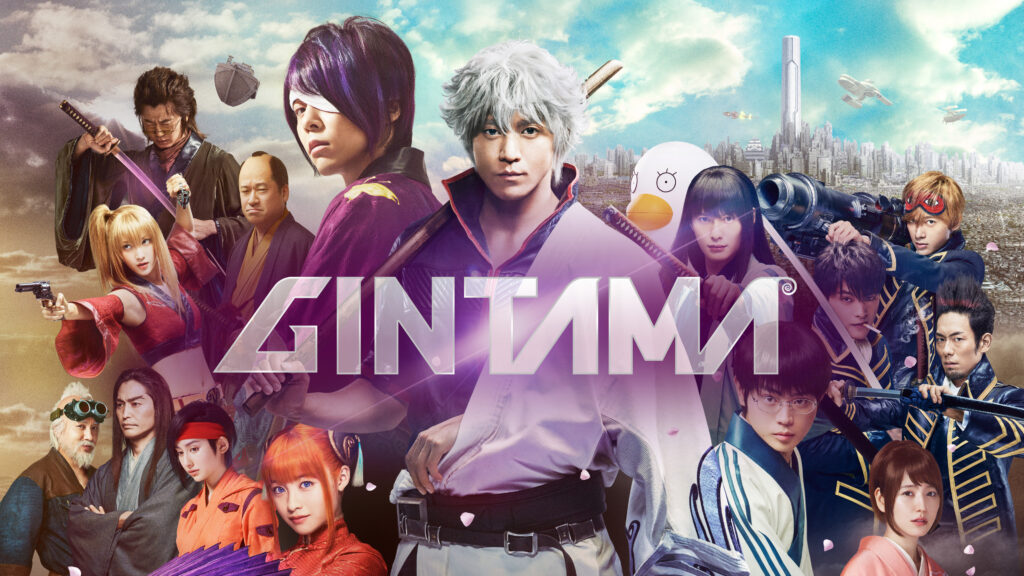
Gintama Live-Action Movie: Samurai, Aliens and Total Chaos

Aliens, samurai, sword fights, giant beetles, and nonstop comedy—Gintama is anything but an ordinary live-action manga adaptation.

Based on Hideaki Sorachi’s popular manga and anime series, the 2017 Japanese movie stars Shun Oguri as the silver-haired samurai Gintoki Sakata, alongside Masaki Suda as Shinpachi and Kanna Hashimoto as Kagura.

Whether you are already a Gintama fan or completely new to its chaotic world, the live-action movie offers an entertaining mix of action, comedy, science fiction, and surprisingly heartfelt friendship.

Gintama is now available to watch on Amasian TV.

Watch Gintama on Amasian TV

What Is Gintama About?

Gintama takes place in an alternate Edo period where aliens known as the Amanto have conquered Japan. Samurai have lost their former status, swords are banned, and advanced alien technology has transformed the city.

In the middle of this strange new world lives Gintoki Sakata, a lazy, sugar-loving former samurai who runs an odd-jobs business called Yorozuya.

Gintoki works alongside Shinpachi Shimura, an earnest young samurai-in-training, and Kagura, a cheerful alien girl with extraordinary strength and an enormous appetite.

Their ridiculous everyday adventures become much more dangerous when Gintoki is asked to investigate Benizakura, a powerful mechanical sword connected to a series of attacks. Meanwhile, his old friend Kotaro Katsura disappears after encountering a mysterious swordsman.

The investigation eventually leads the Yorozuya team to Shinsuke Takasugi, a dangerous rebel connected to Gintoki’s past.

Meet the Live-Action Yorozuya

Shun Oguri as Gintoki Sakata

Gintoki may appear lazy and irresponsible, but behind his carefree personality is a highly skilled former warrior who will do almost anything to protect his friends.

Masaki Suda as Shinpachi Shimura

Shinpachi is usually the most reasonable member of Yorozuya—which means he spends much of the movie reacting to everyone else’s ridiculous behavior.

Kanna Hashimoto as Kagura

Kagura combines an innocent appearance with incredible physical strength, a blunt personality, and some of the movie’s wildest comedy.

Together, the three actors capture the dysfunctional but lovable chemistry that made Yorozuya the heart of the original series.

Why Gintama Is Different from Other Samurai Movies

Most samurai movies do not include alien spaceships, robots, pop-culture parodies, or heroes hunting giant beetles.

Gintama combines historical Japan with science fiction and then refuses to treat either genre seriously. Characters break dramatic tension with jokes, make exaggerated manga-style expressions, and frequently parody other entertainment franchises.

However, the movie is not only comedy. Behind the absurdity is a story about three former comrades—Gintoki, Katsura, and Takasugi—who survived the same war but chose very different paths afterward.

That combination of ridiculous humor and genuine emotion is what gives Gintama its distinctive personality.

Five Fun Facts About the Gintama Live-Action Movie

1. It Adapts One of Gintama’s Most Popular Storylines

The movie primarily adapts the Benizakura Arc, an important storyline that reveals more about Gintoki’s past and his complicated relationships with Katsura and Takasugi.

2. The Giant Beetle Hunt Comes from the Original Series

The bizarre beetle-hunting sequence is not random material invented for the movie. It is inspired by a comedic storyline from the original Gintama manga and anime.

Only Gintama could connect a giant beetle competition with a dangerous samurai conspiracy in the same movie.

3. Shun Oguri Had Already Been Parodied by Gintama

Before Shun Oguri was cast as Gintoki, the Gintama anime had already included a comedic caricature inspired by the actor. That made his eventual casting as the live-action Gintoki especially amusing for longtime fans.

4. Anime Voice Actors Also Appear in the Movie

The live-action production retains connections to the anime through its voice cast. Mikako Takahashi voices Sadaharu, while Koichi Yamadera voices Gintoki’s former teacher, Shoyo Yoshida.

5. The Movie Became a Major Japanese Box-Office Hit

Gintama was one of Japan’s biggest domestic live-action releases of 2017. Its success led to the 2018 sequel, Gintama 2: Rules Are Made to Be Broken.

Do You Need to Watch the Anime First?

No. The movie introduces the main characters, the alien-controlled Edo setting, and the central conflict, so newcomers can enjoy it without watching the anime first.

Existing fans will recognize more of the references and inside jokes, but the live-action film also works as an introduction to Gintoki and the Yorozuya team.

Watch Gintama on Amasian TV

If you enjoy Japanese action comedy, eccentric anime characters, samurai battles, or stories that shift effortlessly between ridiculous and emotional, add Gintama to your watchlist.

Enter a version of Edo where aliens rule the city, samurai take odd jobs to survive, and almost anything can happen.

Watch the Gintama live-action movie now on Amasian TV

Share: Facebook Twitter Linkedin